Shared, anonymised insights that help middle leaders turn lesson evidence into collective action.
Schools asked for a better way to turn what teachers are already learning through Starlight into focused, sustained improvement across their departments. So we built Starlight’s new Department Dashboard to give middle leaders a clear picture of the strengths, growth areas and practical next steps emerging across their team – without exposing or evaluating individual teachers.
It extends Starlight’s teacher-first approach from private reflection to collective professional learning, while preserving the principle on which the platform was built:
Coaching, not compliance. Growth, not grading. Insight, not surveillance.
Department Dashboard Walkthrough Video
This walkthrough explains how departments are created, how monthly reports work, how teachers control their contributions and how privacy safeguards prevent individual monitoring. It also shows how departmental context, activity insights and PDF exports can support sustained professional learning.
Watch nowWhy we built it
Middle leaders are the engine room of school improvement.
They are close enough to the classroom to understand the realities of teaching their subject, but strategically placed to turn that understanding into curriculum decisions, shared practice and professional learning.
As Estyn’s work on developing middle leadership recognises, effective middle leaders guide staff, shape curriculum delivery, mentor colleagues and translate school priorities into improvements for pupils.
Yet the evidence available to them is often incomplete. A handful of observations, occasional learning walks and assessment data can all be valuable, but each offers only part of the picture.
Meanwhile, teachers using Starlight are learning from entire lessons: noticing recurring patterns, testing small changes and receiving feedback that is specific, timely, actionable and regular.
The question our schools asked was simple:
Could Starlight help departments learn collectively without compromising the privacy and professional trust of individual teachers?
The Department Dashboard is our answer.
From individual lessons to shared departmental insight
An organisation administrator can create a department by going to Organisations, selecting View Dashboard, opening the Departments tab and choosing Create Department.
They can then:
- Name and describe the department
- Add or remove members
- Assign a Head of Department
- Add context about the department’s current priorities
Once established, every member can access the same Department Dashboard through My Department.
That last point matters. The dashboard is not a private leadership view of teachers. It is a shared professional learning space. Everyone in the department sees the same report.
A monthly report is generated on the first of each month, covering the month that has just ended, provided the participation threshold has been met. Towards the end of the month, the Head of Department receives a readiness reminder, giving the team time to contribute enough lessons for a report.
What the Department Dashboard shows
Each report turns the shared evidence from across the department into five connected areas.
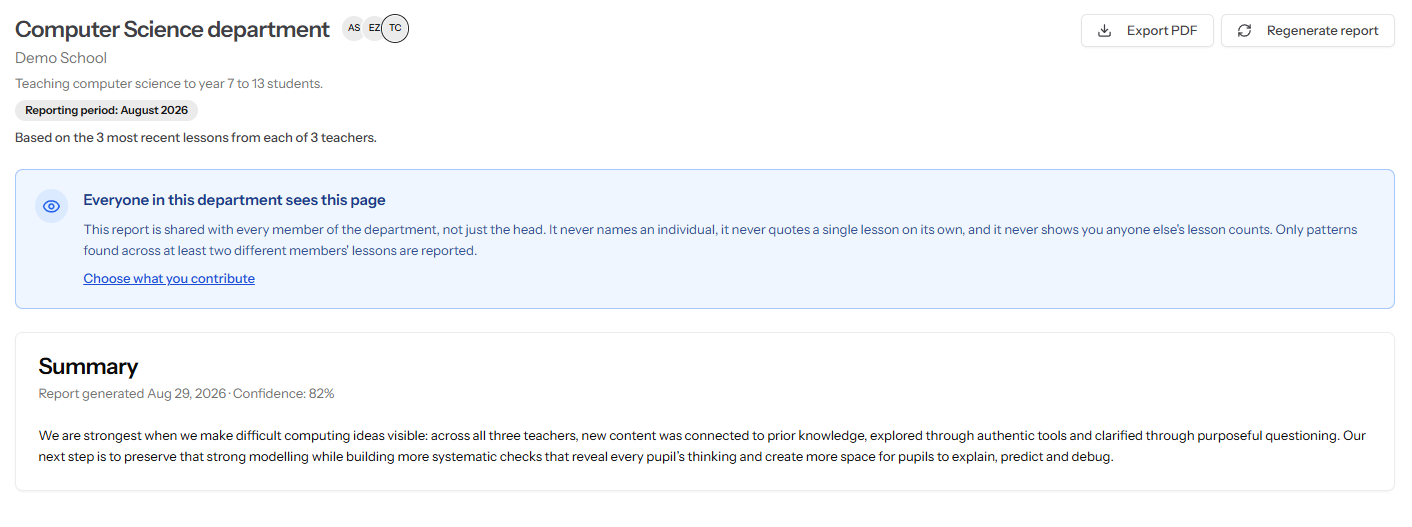
A clear departmental summary
The report begins with a concise overview of what appears strongest across the sample and where the most valuable opportunity for development lies.
It is designed to give a middle leader an immediate answer to two important questions:
- What should we protect and build upon?
- What would make the greatest difference next?
Collective strengths
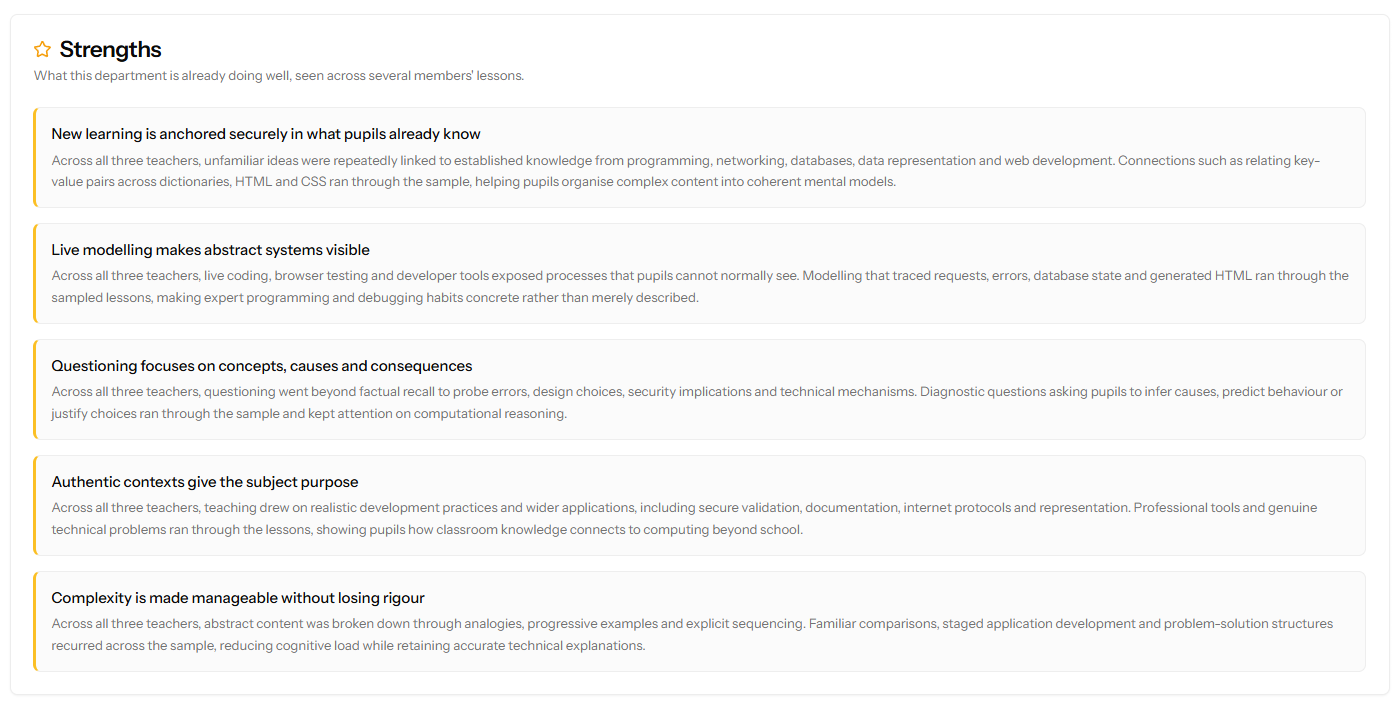
The dashboard identifies effective practices found across several members’ lessons.
In our demonstration Computer Science report, for example, the analysis recognised recurring strengths in connecting new learning to prior knowledge, making abstract systems visible through live modelling, asking questions about causes and consequences, and using authentic professional contexts.
These are not generic compliments. They are patterns grounded in the lessons contributed by the department.
Shared growth areas
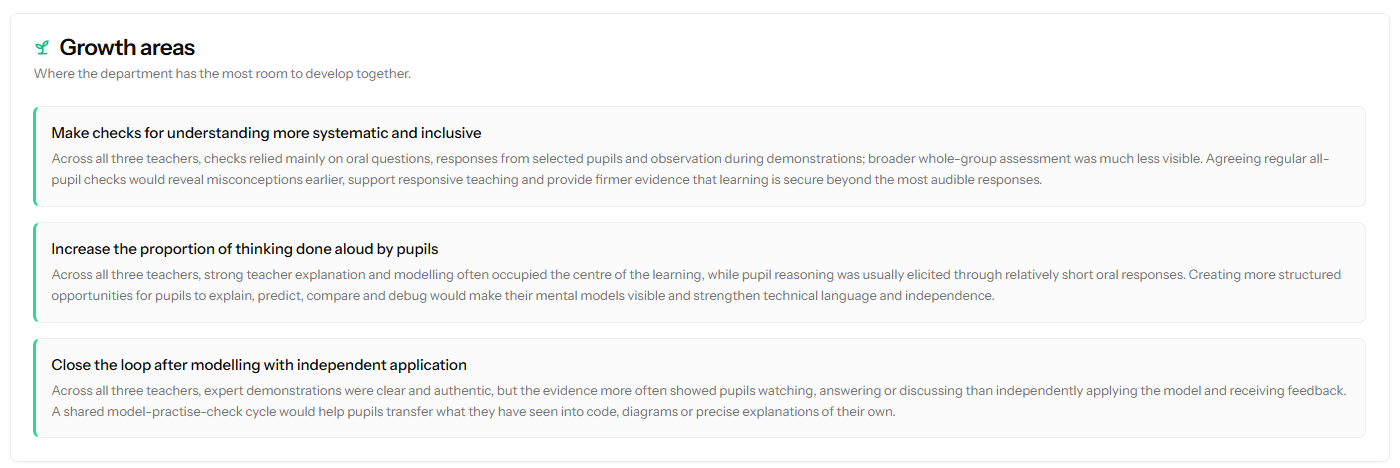
The report then identifies a small number of areas where the department could develop together.
In the Computer Science example, these included making checks for understanding more systematic, increasing the amount of pupil reasoning made visible and following expert modelling with more independent application.
The focus is deliberately collective. The question is not, “Which teacher needs fixing?” It is, “What could we learn and strengthen together?”
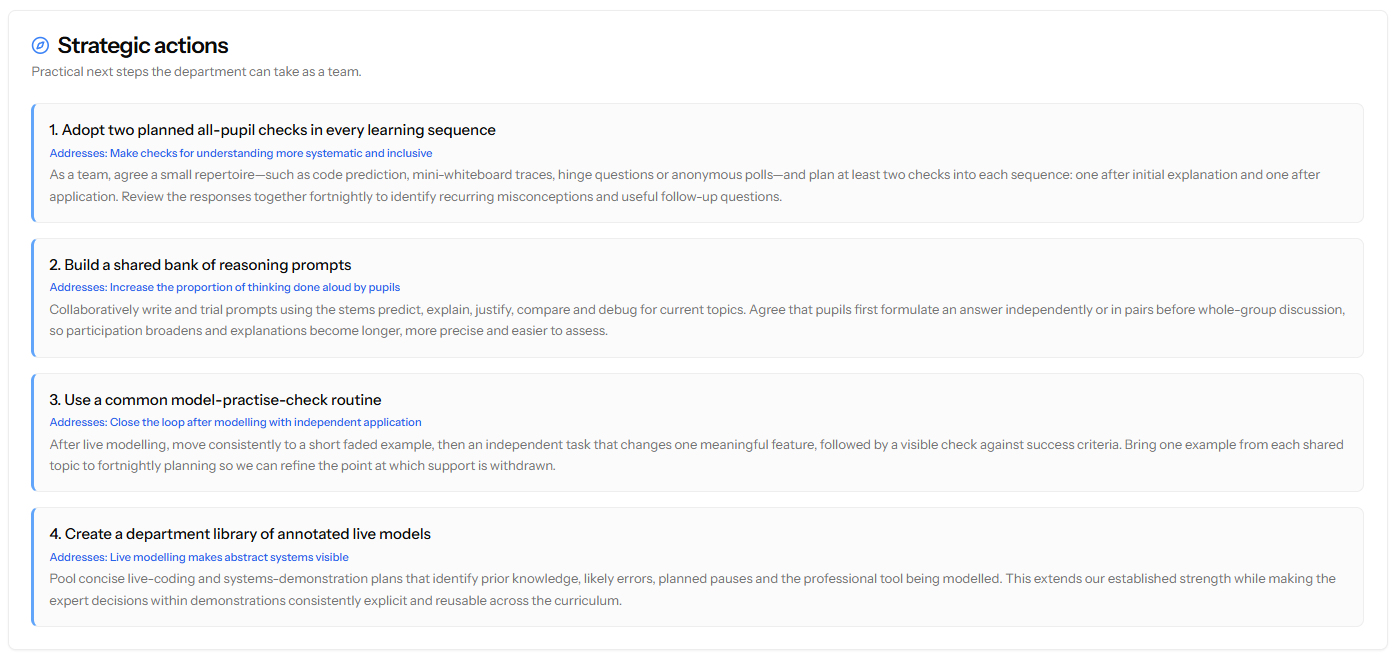
Strategic actions
Insight matters only when it changes what happens next.
For each growth area, Starlight proposes practical departmental actions. These might include adopting shared all-pupil checks, developing a bank of reasoning prompts or agreeing a common model-practise-check routine.
This brings our approach to specific, timely, actionable and regular feedback to the level of the department. It gives middle leaders something concrete around which to organise planning, professional dialogue, collaborative enquiry or coaching.
This also reflects the Education Endowment Foundation’s guidance on effective professional development, which emphasises carefully designed professional learning focused on changes in classroom practice, and the Department for Education’s standard for teachers’ professional development.
Participation and departmental activity
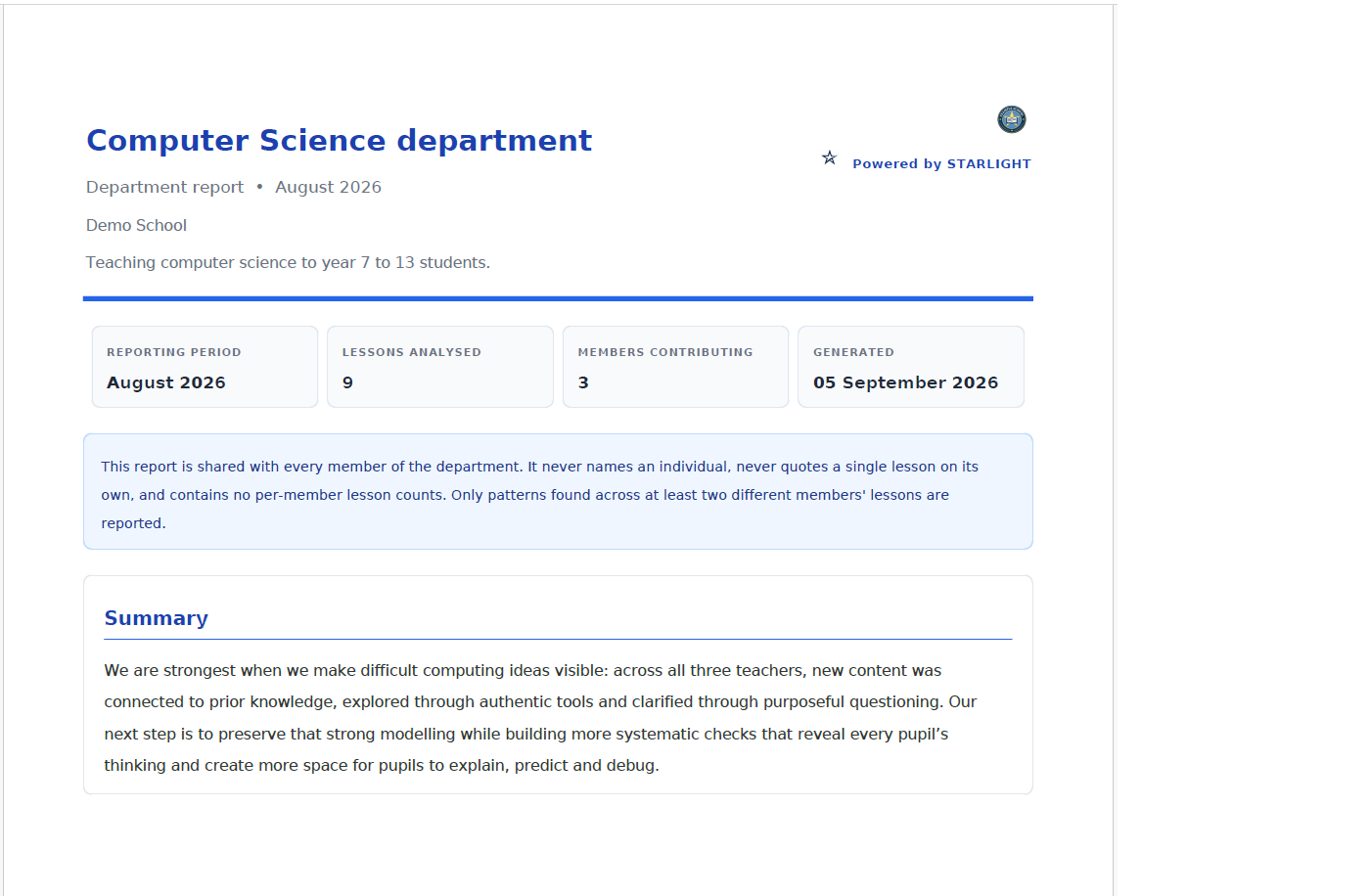
The dashboard explains how the report was constructed, including:
- The total number of lessons analysed
- The number of participating members
- The equal number of lessons sampled from each participant
- Recent activity across the department
Each teacher can also see their own upload and contribution figures. These are visible only to them.
The report can be exported as a PDF, making it easy to use in departmental planning, professional learning meetings or ongoing improvement work.
Designed for trust
The most important feature of the Department Dashboard may be what it does not show.
It does not name an individual teacher.
It does not reproduce a quotation from one lesson in isolation.
It does not display one teacher’s lesson count to their colleagues.
It does not rank, score or compare members of the department.
Only patterns found across the lessons of at least two different members can appear in the report.
A report is produced only when at least three members have each uploaded three or more lessons during the month. Every participating member then contributes the same number of lessons, up to a maximum of five, so no single teacher can dominate the analysis.
Even the activity display has been designed with this principle in mind: a day appears only when at least two different members taught on it, preventing activity from being traced back to one person.
Most importantly, teachers decide whether their lessons contribute to departmental insights.
These are not peripheral safeguards added at the end. They are part of the architecture of the feature because professional learning depends on professional trust. We explored that principle in more depth in Trust Is the Real Test for AI Coaching.
Every school using Starlight also signs our North Star Charter, committing never to use the platform for surveillance or performance management.
We are building primarily for teachers. Middle and senior leaders benefit because teachers can trust the process – not at the expense of that trust.
Context that makes the analysis more useful
No two departments are working on precisely the same priorities.
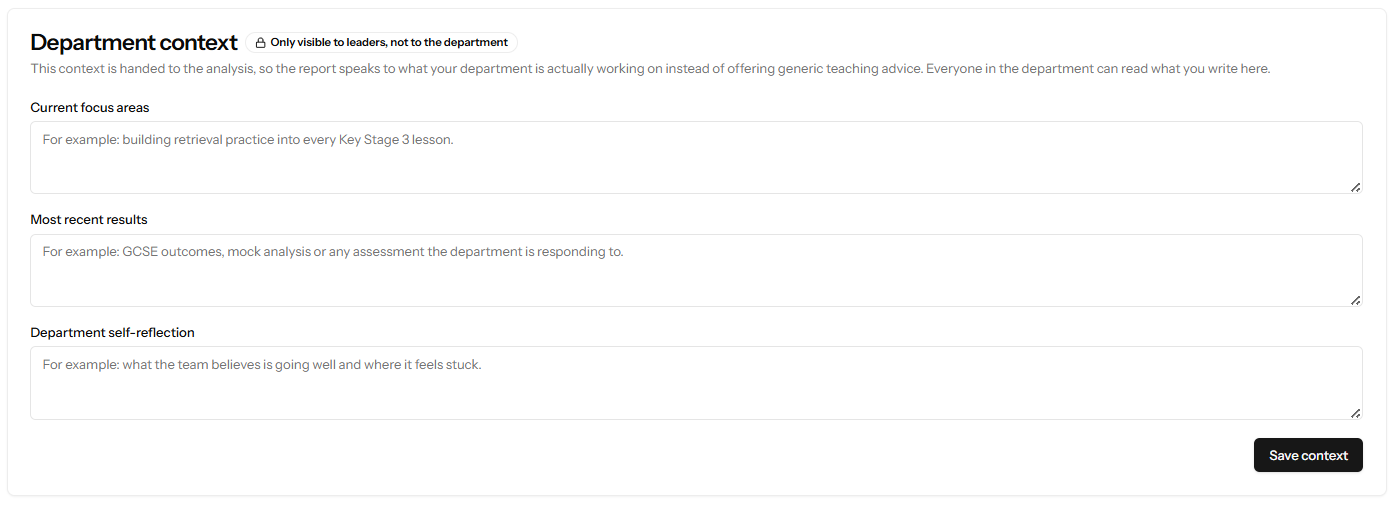
Middle leaders can therefore add their departmental context, including:
- Current focus areas
- Recent results
- Departmental self-reflection
Starlight uses this context when generating the report, helping the analysis respond to what the team is genuinely trying to achieve rather than offering detached or generic advice.
A stronger professional learning loop
A dashboard cannot improve teaching on its own.
Its value lies in the conversations, decisions and deliberate practice it supports.
A middle leader might use the report to recognise a strength worth spreading, select one shared growth area for the next half-term, shape a departmental professional learning session or agree a small technique that colleagues will trial and revisit.
That is the difference between collecting data and building a learning loop.
The shift from occasional CPD to sustained professional learning requires evidence, focus, action and follow-up. The Department Dashboard helps middle leaders bring those elements together without adding another round of observations or another reporting burden.
Individual reflection remains private and teacher-controlled.
Shared patterns become visible.
Departmental priorities become more precise.
And middle leaders gain practical evidence with which to lead the next conversation.
Built because schools asked
Starlight is developing quickly because the schools using it continue to challenge us, guide us and show us where it can become more useful.
The Department Dashboard is a direct response to that partnership.
It makes Starlight more valuable at every level of a school while remaining true to the principles with which we began: teacher agency, professional trust and feedback that leads to action.
If you would like to see how the Department Dashboard could support professional learning in your school, book a personalised demonstration.
Spark Insight with Starlight – and turn shared evidence into collective growth.
The Insight Engine is written by Adam Sturdee, co-founder of Starlight, the UK’s teacher-first AI-powered coaching platform, and a senior leader with responsibility for teaching, learning and coaching.
It documents the journey of building Starlight and explores how AI, when shaped with care, can reduce workload, surface insight and help teachers think more deeply about their practice. Rooted in the belief that growth should be private, professional and purposeful, The Insight Engine puts insight – not judgement – at the centre of development.