Ross McGill does not hand out endorsements. Anyone who has followed TeacherToolkit since he started it in 2007 knows that. So when his second piece on Starlight went up on Tuesday, I read it more carefully than I read most things written about our own platform.
It is called Why Coaching Stalls In Schools, and it is worth ten minutes of your time whether or not you ever look at Starlight, because it names a problem that almost every coaching lead I know will recognise straight away.
The problem is not the model
Ross is a big fan of instructional coaching, and so am I. Done well, a skilled coach and a teacher agree a precise focus, gather evidence from the classroom, and talk about it in a way that produces small, deliberate improvements over time. The research base is strong. The intent in schools is nearly always sincere.
And yet coaching stalls. Ross describes the pattern exactly. Programmes launch with ambition, then the logistics bite. Coaches are stretched. Timetables clash. Cover is tight. Priorities shift. What started as weekly becomes fortnightly, then monthly, then occasional.
I have led coaching in a secondary school since 2019, and I can tell you he is right. I can also tell you that the stall is rarely anyone's fault. Nobody decides to stop coaching. It simply gets outcompeted, week after week, by everything else that is also urgent. Ross's diagnosis is the one I keep coming back to: the problem is not the coaching model, it is the infrastructure a school needs to sustain that model for every teacher, all year.
Harvard's Center for Education Policy Research has been looking at the same bottleneck from the other side of the Atlantic. Their coaches can spend two to three hours preparing for a single debrief with one teacher. With arithmetic like that, coaching cannot reach every teacher regularly, however committed the school is. It gets rationed. And once it is rationed, it starts to look like a remedy for the struggling rather than an entitlement for everyone, which is the argument I made earlier this year in Coaching as a right, not a remedy.
A sceptic's case for AI
What I value most about Ross's piece is that he starts from scepticism, in writing, in public. When someone suggests that AI can coach teachers, his first reaction is doubt. Can it understand the context of a department? Can it read the relationship between a teacher and a pupil? Can it sense the emotional temperature of a room? His answer is no, not in the way a great human coach can.
I agree with every word, and I co-founded the company.
The argument he lands on instead is the one we have been making since the first day of Starlight: AI does not replace instructional coaching, it extends it. That distinction is the whole game. A tool that positions itself as the coach will be rejected by teachers, and rightly so. A tool that helps the human coaching conversation happen more often, with better evidence in front of both people, is a different proposition altogether.
Coaching between coaching
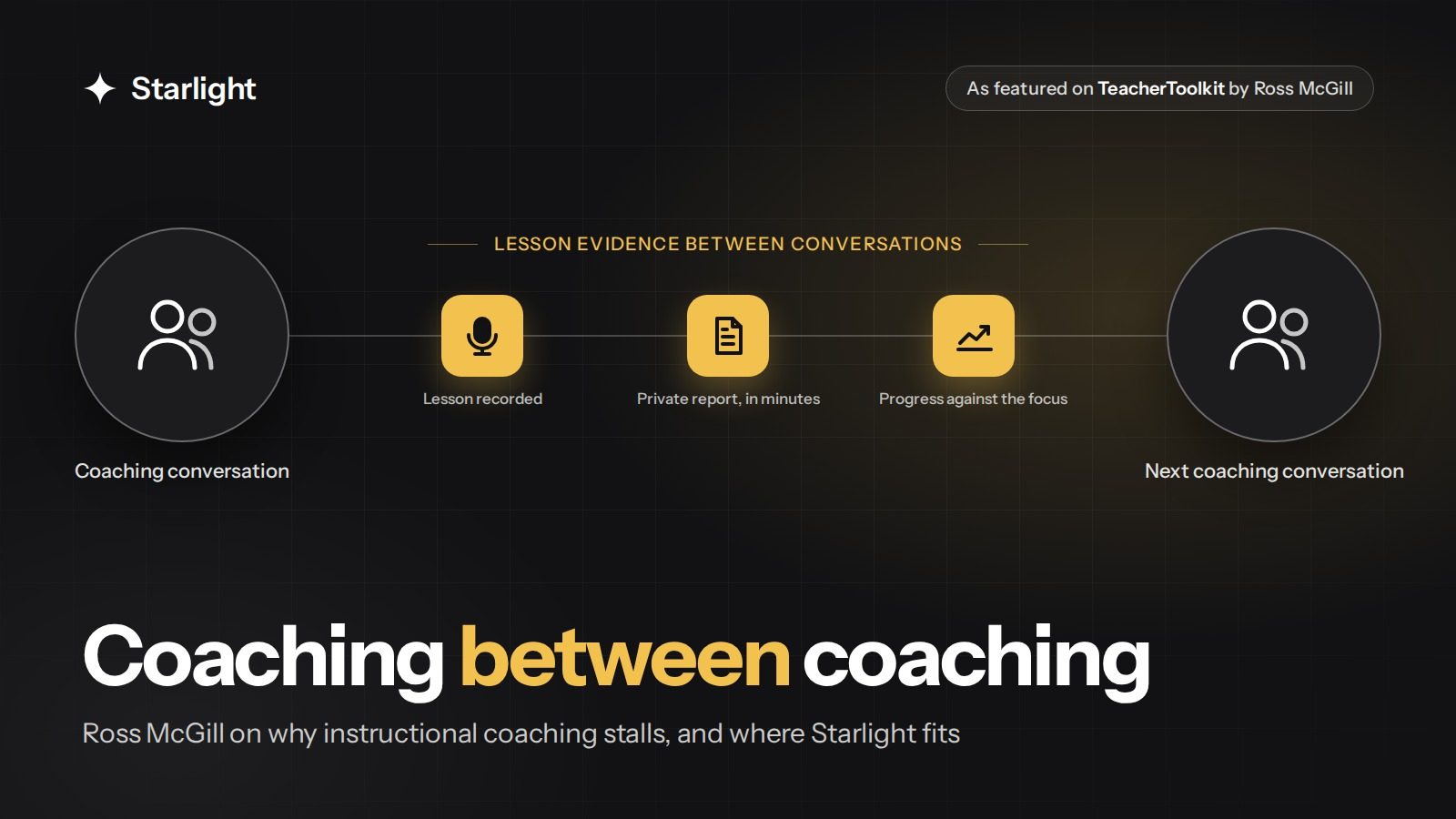
Ross gives that proposition a name, coaching between coaching, and I think it is the most useful description of Starlight anyone has written, including us.
Here is how it works in a school. A coach and a teacher agree a development focus together, exactly as they always have. That focus is logged in the teacher's Actions area in Starlight. Between coaching conversations, the teacher records a lesson, uploads the audio, and receives a private whole-lesson report within minutes. The report looks specifically for evidence against the agreed focus, so when the two of them next sit down they are not working from memory and a hastily scribbled note. They have a transcript, a report, and a development trace across several weeks. The conversation starts from evidence rather than recollection.
Nothing about the human relationship changes. The coach still sets the direction, still asks the questions that matter, still brings the professional judgement that no model has. What changes is the gap between conversations, which is precisely where most coaching cycles quietly die. It is also why we built Feedback Friday, a weekly prompt to upload one lesson, because regularity is what turns a good coaching conversation into a changed habit.
The Harvard team reached a similar conclusion. When teachers were given automated lesson feedback with no human coaching cycle around it, they barely used the tool and changed little. With a coach in the loop, preparation time fell from hours to as little as fifteen minutes, and the conversations got sharper. Ross puts the same idea in seven words: "Coaching stays human. AI provides the evidence."
Trust comes first, or it does not work at all
Ross is explicit that if Starlight ever became a surveillance tool, he would not support it. Neither would I, and the platform is built so that it cannot quietly drift in that direction.
Individual reports are private to the teacher. School leaders see anonymised, aggregated trends, never a named teacher's report. Teachers can delete their own data. The school remains the Data Controller, hosting is in the EU, and there is a published DPIA. We wrote about why this matters more than any feature in Trust is the real test for AI coaching, after Ross's first piece in June, and nothing since has changed our view. Instructional coaching depends on psychological safety and professional agency. Any tool that erodes those has already failed, whatever its reports look like.
This is also where AI coaching lines up with what we know about professional development more broadly. The Education Endowment Foundation's guidance on effective professional development is clear that professional learning changes practice when it builds knowledge, motivates teachers, develops specific techniques, and embeds them over time through feedback, prompts and action planning. Coaching between coaching is a way of delivering that last mechanism at a frequency most schools have never been able to afford.
What this looks like for your school
For leaders, Ross's summary is the one I would put in front of any SLT: more frequent reflection without adding a single observation to the calendar. For coaches, better raw material and far less time reconstructing what happened in a lesson. For teachers, regular feedback between coaching sessions, on their own terms, without waiting weeks for the next meeting.
If you run coaching in your school and you recognise the stall, the simplest way to test the idea is to try it. Our Launchpad programme gives five teachers four weeks of Starlight, free. Pick a coaching pair or two, agree a focus, upload a lesson a week, and see what the next coaching conversation feels like when the evidence is already on the table.
Start a free Launchpad trial or book a demo and we will walk you through it.
And do read Ross's piece. He was sceptical, he asked the hard questions first, and he has ended up describing exactly what we hope Starlight can be for schools: not a replacement for coaching, but the thing that keeps it alive between conversations.
Spark Insight with Starlight, and keep coaching human.
Book a demo to see Starlight in action: https://starlightmentor.com/demo-request
🎥 Subscribe to our channel here: https://www.youtube.com/@Star21-ai
🌐 Read more on our blog: starlightmentor.com/blog
💡 Explore the platform: www.starlightmentor.com
🐦 Follow us on X: @star21starlight
The Insight Engine is written by Adam Sturdee, co-founder of Starlight, the UK's first AI-powered coaching platform, and a senior leader with responsibility for teaching, learning and coaching. This blog is part of a wider mission to support educators through meaningful reflection, not performance metrics. It documents the journey of building Starlight from the ground up, and explores how AI, when shaped with care, can reduce workload, surface insight, and help teachers think more deeply about their practice. Rooted in the belief that growth should be private, professional, and purposeful, The Insight Engine offers ideas and stories that put insight, not judgment, at the centre of development.