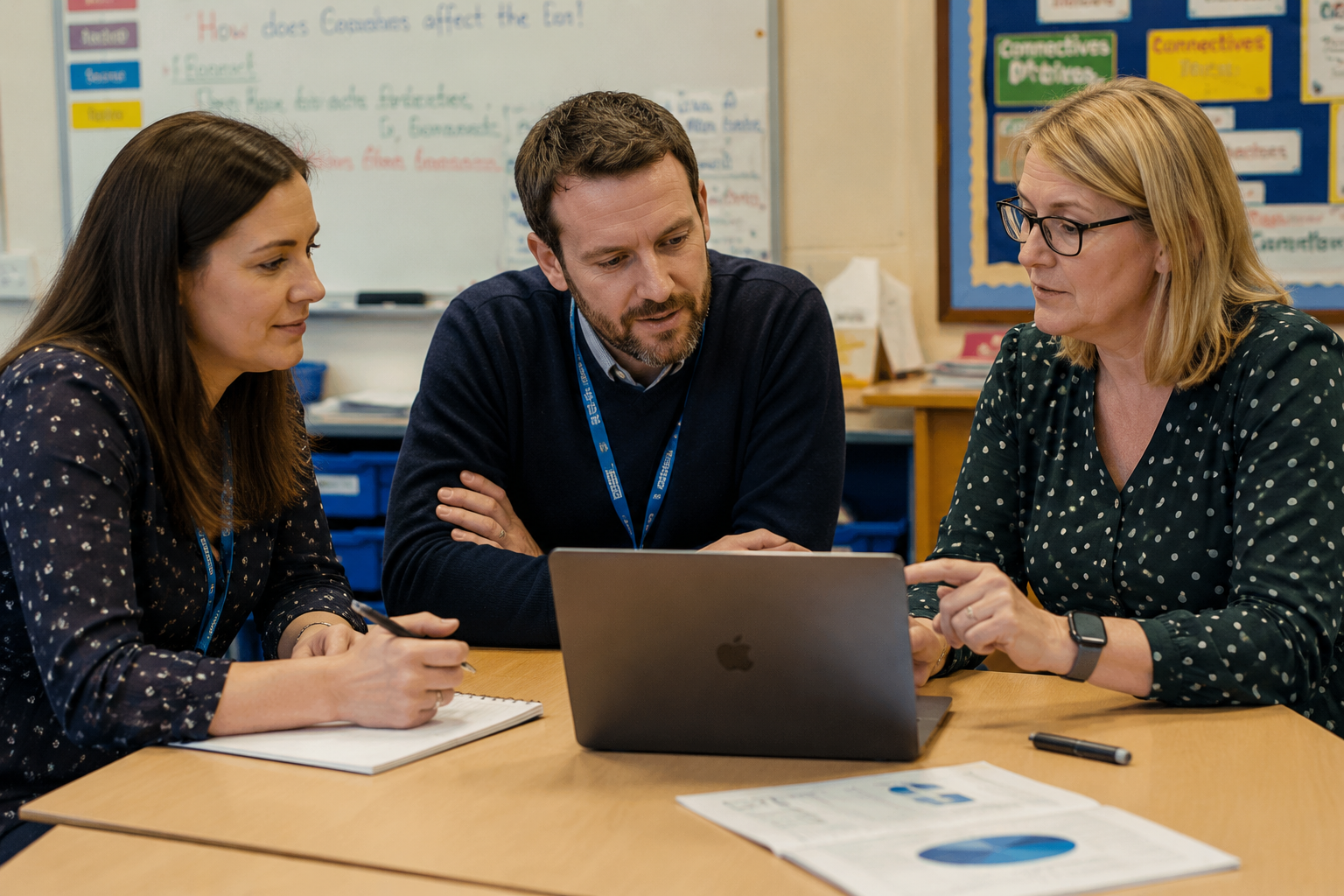
Why the inspection vocabulary has changed, and why the evidence got there first.
Here is a small linguistic detail with large implications. When Ross McGill of TeacherToolkit analysed Ofsted’s new Schools Inspection Toolkit earlier this year, he found the phrase ‘professional learning’ fifteen times. The phrase ‘CPD’ does not appear once.
That is not an accident of drafting. Words carry intent, and the intent here is unmistakable. The renewed framework, published in November 2025, expects schools to offer staff a professional development programme that is ‘high-quality, evidence-informed, sustained and coherent’. And this week, at the Festival of Education at Wellington College, Sir Martyn Oliver gave a dedicated session on the inspectorate’s approach to professional development. When the Chief Inspector chooses to spend one of the sector’s biggest platforms of the year on how teachers learn, rather than only on how pupils are taught, something has shifted.
What actually changed
For decades, CPD in most schools has meant events. An INSET day in September. A twilight in November. An external speaker in the spring. Each one planned with care, each one often genuinely good, and each one largely forgotten by half term because nothing connected it to the next one, or to what happened in classrooms in between.
The new language of sustained professional learning describes something structurally different. Not a calendar of occasions but a continuous process: teachers developing expertise over time, with regular cycles of practice, feedback and refinement, joined up coherently rather than scattered across the year.
Ofsted did not invent this. The evidence did
This is the part worth holding on to, because no school should redesign its professional development to please an inspector. The reason to take this shift seriously is that the inspectorate is catching up with what the research has been saying for years.
The Education Endowment Foundation’s guidance on effective professional development identifies the mechanisms that make teacher learning stick: building knowledge, motivating teachers, developing teaching techniques and embedding practice. Look at that last one. Embedding. It is the mechanism most obviously absent from the one-off model, and the one that only sustained approaches can deliver. A single training day can build knowledge and even inspire. It cannot embed anything, because embedding happens in classrooms, over weeks, through repetition and feedback.
Every teacher already knows this instinctively. We would never teach pupils a concept once in September and expect secure recall in July. We space practice, we revisit, we check understanding, we give feedback that is close to the moment of performance. The case for sustained professional learning is simply the case for applying to teachers what we already know about learning itself. That it now appears in an inspection framework is confirmation, not revelation.
The hard question for school leaders
So far, so agreeable. The difficulty starts on a wet Wednesday in November, when the theory meets the timetable.
Sustained professional learning depends on frequency, and frequency is exactly what most schools cannot resource. Instructional coaching is probably the best-evidenced form of sustained teacher development we have, but a coach can only be in one classroom at a time. In a typical secondary school, even a generous coaching programme reaches each teacher a handful of times a year. The feedback loop that makes learning sustained, regular, specific and close to practice, is precisely the loop that human capacity constrains.
This is why so many schools that sincerely believe in sustained professional learning still, in practice, run an events model. Not because leaders lack conviction, but because the alternative has never scaled.
Making sustained learning practically possible
This is the problem we built Starlight to solve. A teacher records a whole lesson on a small audio device, uploads it, and receives a private, developmental coaching report within minutes: strengths evidenced from the transcript, a small number of high-leverage next steps, and prompts for reflection. No grading. No observer in the room. No performance judgement.
Because the report arrives quickly and the process takes minutes rather than hours of anyone’s time, teachers can repeat it as often as they wish. That is the point. One report is an interesting mirror. A sequence of reports across a term is sustained professional learning: feedback that is specific, timely, actionable and, crucially, regular. What we call STAR feedback. The coaching conversation that a school could previously offer each teacher once or twice a year becomes available every week, for every teacher who wants it, without adding a single observation to anyone’s calendar.
Coherence, the other word in the framework’s expectation, is addressed at whole-school level. Leaders see anonymised, aggregated trends rather than individual data, which means professional learning priorities can be shaped by what is genuinely happening across classrooms rather than by intuition or by whichever course brochure arrived that week. The teacher’s learning stays private. The school’s learning becomes visible.
A caution, in both directions
Two things can be true at once. It is genuinely encouraging that the inspection framework now describes professional development the way the evidence describes it. And it would be a mistake for any school to adopt any tool, ours included, as an inspection response. Anything introduced to satisfy an external audience will be experienced by teachers as compliance, and compliance is where professional learning goes to die.
The right reason to build sustained, regular, low-stakes feedback into every teacher’s working week is that it helps teachers get better, and teachers getting better is the single most powerful lever a school has for its pupils. If the consequence is that your professional learning offer also happens to look exactly like what the renewed framework describes, that is a happy by-product of doing the right thing, not the goal.
The vocabulary has changed. The evidence never did. Schools that build STAR feedback, feedback which is specific, timely, actionable and regular, into the ordinary rhythm of teaching will find they were aligned with this moment long before it arrived.
Book a demo. Interested in seeing how Starlight can support sustained professional learning at your school? Select a convenient time to schedule your personalised demo at starlightmentor.com/demo-request.
Spark Insight with Starlight, and let professional learning outlast the INSET day.
🎥 Subscribe to our channel here: https://www.youtube.com/@Star21-ai
🌐 Read more on our blog: starlightmentor.com/blog
💡 Explore the platform: www.starlightmentor.com
🐦 Follow us on X: @star21starlight
The Insight Engine is written by Adam Sturdee, co-founder of Starlight, the UK’s first AI-powered coaching platform, and a senior leader with responsibility for teaching, learning and coaching. This blog is part of a wider mission to support educators through meaningful reflection, not performance metrics. It documents the journey of building Starlight from the ground up, and explores how AI, when shaped with care, can reduce workload, surface insight, and help teachers think more deeply about their practice. Rooted in the belief that growth should be private, professional, and purposeful, The Insight Engine offers ideas and stories that put insight, not judgment, at the centre of development.