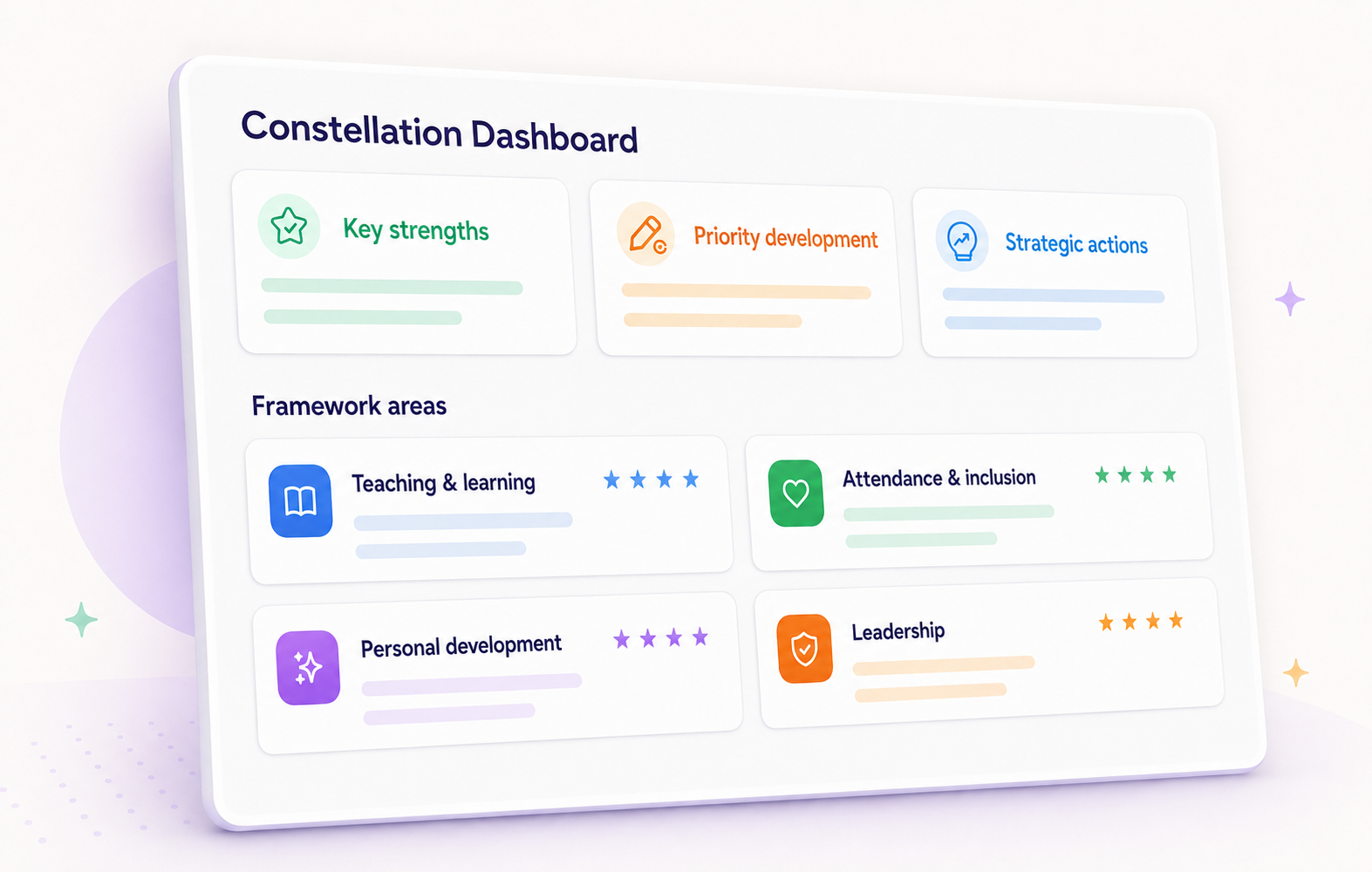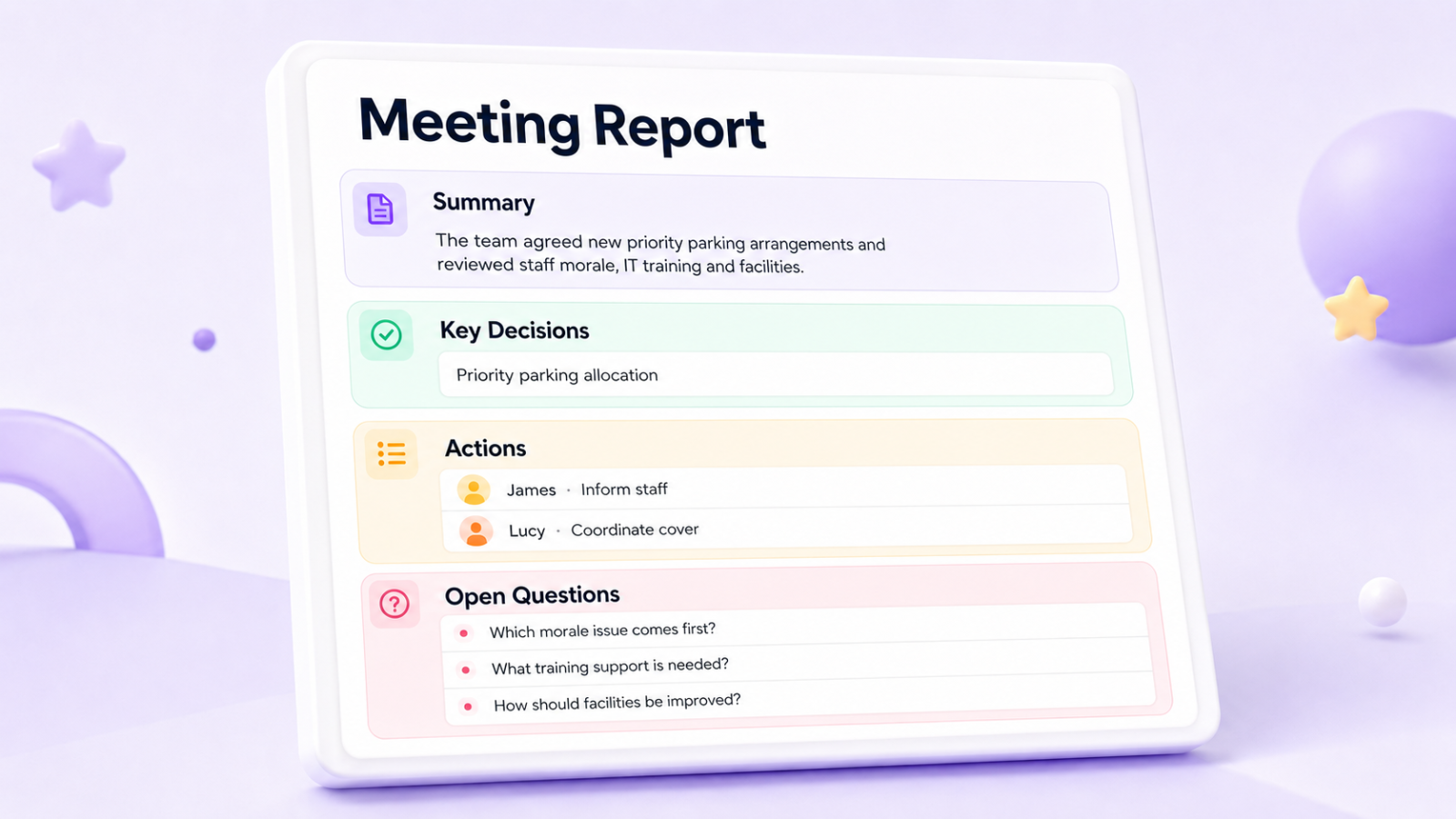
Teachers should be able to shape the feedback they receive. What deserves their attention, which patterns they want to explore, and whether a score helps them think should be decisions they can make for themselves.
That principle sits behind two new controls in Starlight’s lesson feedback report. You can now choose which elements of Classroom Discourse Analysis appear, and you can hide the rating scale and scores with a single click. Your saved preferences also become the default for future uploads.
These are small controls with a substantial purpose: giving teachers more ownership of their professional learning. We built them in response to teachers telling us what they value, what distracts them, and what they would rather leave out. Thank you. That feedback changes what we build.
The discourse analysis menu lets you switch each of these six elements on or off:
- Lesson Flow: a timeline showing patterns of predominantly teacher talk, back-and-forth exchanges, and little or no talk. You can select a minute to revisit that point in the recording.
- Talk Time Balance: the estimated balance of teacher and student talk, alongside silence and pauses, as a starting point for thinking about participation and instruction.
- Thinking Time: the pauses detected after questions that invite a pupil response, helping you examine how much space pupils had to formulate an answer.
- Question Mix: an AI-generated breakdown of questions across remembering, understanding, applying, analysing, evaluating and creating.
- Interaction Modes: an indicative picture of whole-class, small-group and one-to-one interaction, including moments the system cannot confidently classify.
- Lesson Climate: a descriptive balance of encouraging, instructional and corrective language.
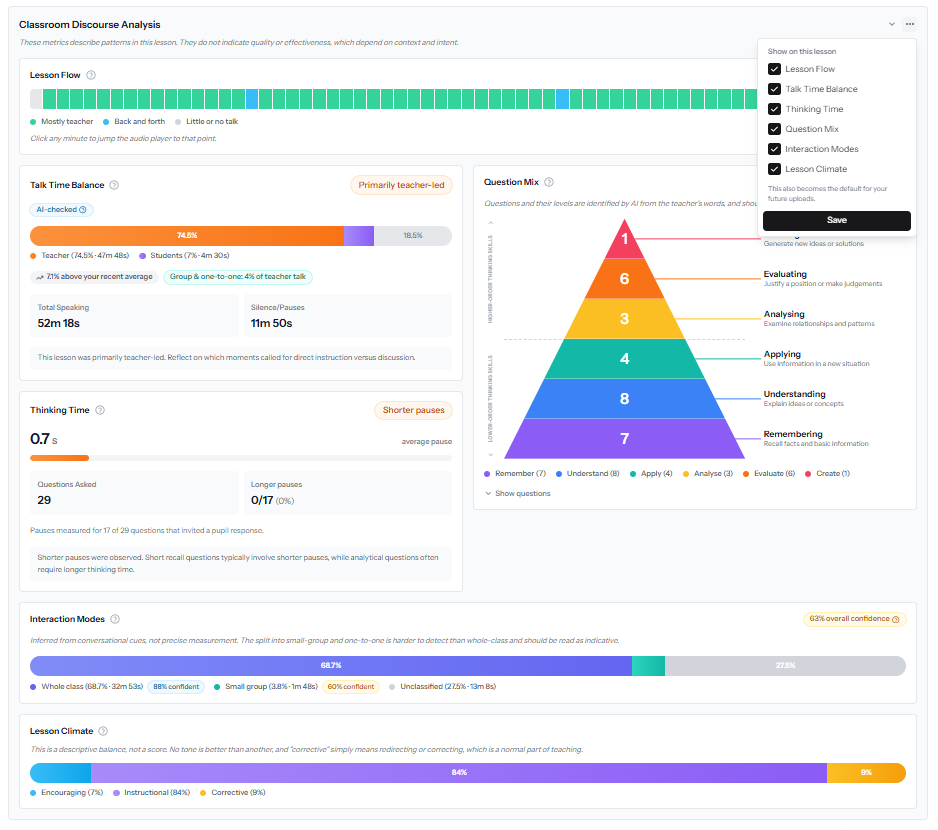
Open the three-dot menu beside Classroom Discourse Analysis, tick the elements you want to see, and select Save. The choice applies to this lesson and becomes your default for future uploads. You can return to the menu when your priorities change.
Perhaps you are exploring questioning this half-term. Keep Question Mix and Thinking Time visible. Perhaps you want to revisit the rhythm of explanation and discussion: Lesson Flow and Talk Time Balance may be more useful. If an element does not help your reflection, hide it. You can sculpt the display around your interests, your teaching context and the amount of information you find useful.
None of these patterns is a verdict on teaching quality. A lesson involving substantial teacher explanation may be exactly what a class needs. Recall questions have a purpose. Corrective language is a normal part of teaching. The report itself makes this distinction: context and intent matter. Its estimates give you something to investigate; your knowledge of the lesson gives those patterns meaning.
The second change is just as direct. In Personal Feedback, use Hide ratings to switch the rating scale and scores out of view. Switch it back if you want them again. This preference also becomes the default for future uploads.

Some teachers find a numerical scale a useful starting point. Others find that the number draws attention away from the detail. Both responses deserve a place in the design. You can read the written feedback, consider its evidence and choose a next step without a score sitting beside it. Hiding ratings changes the display; you are choosing how to engage with the feedback.
Traditional observation often gives the teacher relatively little choice over the report’s format or whether it contains a grade. AI creates room for a more flexible relationship with feedback: available when you want to reflect, and adaptable to the way you work. Human coaching still offers valuable dialogue, expertise and context. Starlight adds a personal route into reflection between those conversations.
For me, the most useful analogy is a mirror. Imagine mirrors had never been invented. Every time you wanted to know how you looked before leaving the house, you would have to ask somebody else. You would need them to be available, to notice the things that mattered to you, and to describe them in a way you could use.
A mirror gives you the opportunity to look for yourself, privately, whenever you choose. You decide what to examine and what, if anything, to change. That is the kind of agency we want Starlight to offer teachers. We explored that connection between AI literacy and professional autonomy in Why Teachers Must Master AI First.
The analogy has a limit: an AI report is an interpreted, partial reflection. It can misread what happened. A transcript does not capture every gesture, every piece of pupil work or everything you know about a class. The teacher still has to examine the reflection critically.
Teachers sometimes tell us that Starlight has got something wrong. They disagree with an interpretation, question a score, or point out something the system missed. We are grateful for those messages, including the uncomfortable ones. Disagreement can be evidence of careful professional thinking. When the feedback is wrong, that is something for us to investigate and improve.
Those conversations also remind us to attend to trust. If AI feedback feels like surveillance, we need to understand why. A teacher should feel able to challenge the report without having to defend their professionalism. Clear control over what they see is one practical part of creating that relationship. It sits alongside the purpose of Starlight as a private space for reflection and the teacher’s authority to decide what the feedback means for their practice.
This emphasis on agency belongs in the wider conversation about responsible educational AI. UNESCO’s guidance on generative AI in education and research advocates a human-centred approach. Our design response is to make teacher choice visible in the everyday experience of using the report.
There is another risk we need to take seriously: a polished report can appear more authoritative than it deserves. A precise-looking number can encourage us to place too much weight on an uncertain interpretation. Starlight should be a tool you think with. It should never become the final judge or arbiter of your teaching.
Human observers can make mistakes too. Their interpretations can be affected by expectations, fatigue, relationships and the pressures around an observation. Starlight offers a defined process for analysing lesson transcripts, guided by the feedback template being used. That creates a consistent framework for reflection without an individual observer’s mood or personal stake in the outcome.
We should be precise about what that means. A consistent process does not guarantee an objective, unbiased judgement or identical scores every time. AI can reproduce biases, misinterpret context and generate confident errors; its outputs can vary. NIST’s Generative AI Profile identifies risks including confabulation and harmful bias. The useful promise is a structured perspective that you can inspect against the evidence, with professional judgement remaining yours.
If a comment seems wrong, revisit the relevant audio or transcript. Consider what the system may have missed. Accept, adapt or reject the suggestion in light of your knowledge of the pupils and the lesson. Please tell us about the error, too. A reflection tool earns trust by being open to challenge and by improving in response.
The purpose of all this remains the same: feedback that is specific, timely, actionable and regular. In practice, that means:
- Specific: anchored in identifiable moments from your lesson, so you can check the evidence and decide what it means.
- Timely: available while the lesson is still fresh enough to inform what you do next.
- Actionable: helping you choose a manageable adjustment you can try in your teaching.
- Regular: supporting a sustainable habit of reflection, rather than depending entirely on an occasional observation.
Our earlier article, Four words that decide whether feedback works, explores those principles in more depth. They also connect with the Education Endowment Foundation’s guidance on effective professional development, which identifies mechanisms including feedback, goal setting and action planning. Customisation helps teachers focus their attention on the evidence and next step that matter to them.
Teachers have been shaping Starlight throughout its development. Rebecca’s story describes that relationship in practice: a teacher testing ideas, questioning what is useful and helping us see what should come next. These new report controls continue that work.
For us, advancing AI feedback for teachers means being rigorous about its limitations and ambitious about the control it gives teachers. We keep returning to practical questions: does this help a teacher notice something useful, think more clearly or choose a worthwhile next step? Can they set it aside when it does not?
Try shaping your next report around one question you want to explore. Choose the discourse elements that serve that question. Decide whether ratings help. Read the feedback alongside your own understanding of the lesson, then choose what to do with it.
And keep telling us what works, what does not, what we have misunderstood and what you would like to change. Those conversations are helping us build Starlight around the teachers it exists to support. The feedback is yours. So is the professional judgement.
The Insight Engine is written by Adam Sturdee, co-founder of Starlight and a senior leader with responsibility for teaching, learning and coaching. It follows the development of AI that supports teachers’ reflection, professional learning and autonomy.