From the Starlight Transcript Research Lab
On 1 September, mobile phones in England's schools move from guidance to statute. Under the Children's Wellbeing and Schools Act, schools are expected to be phone-free by default across the whole school day, and Ofsted will look at how the policy works in practice on every inspection.
Plenty has been written about what that change should mean. Very little has been written about what classrooms actually sounded like in the year before it. So we looked.
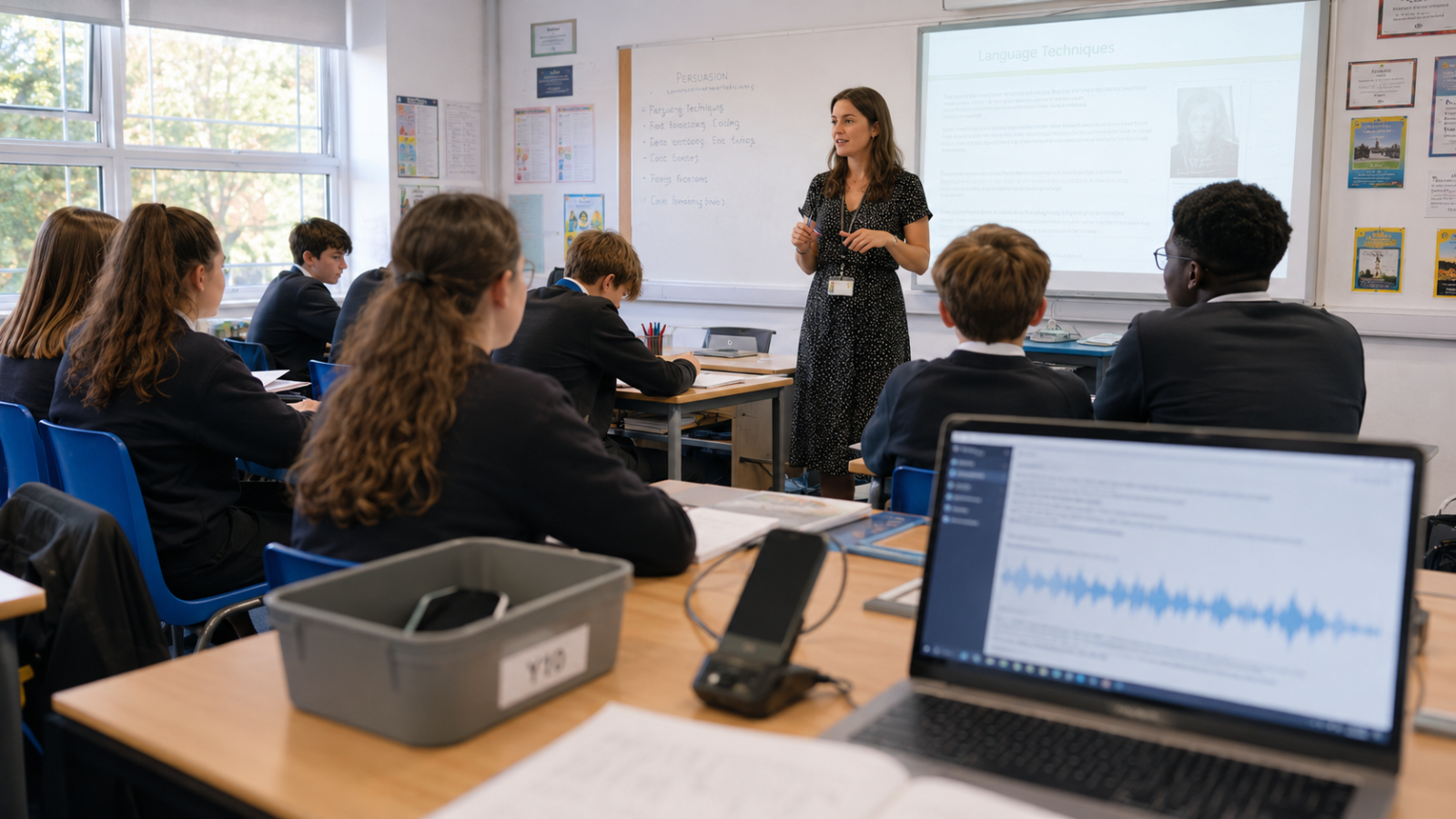
Starlight records and transcribes whole lessons so that teachers can receive private, specific coaching feedback. A by-product of that everyday use is an archive of ordinary classroom talk at a scale that observation cannot reach. For our new report, Phones in the Recorded Classroom, we analysed 4,603 recorded lessons from 15 UK secondary schools across the 2025/26 academic year, around 4,000 hours of classroom audio, and read every phone-related moment by hand rather than relying on keyword counts.
What we found
Three findings stand out.
Phones are talked about far more than they are managed. Phone language appears in roughly 29 per cent of lessons, but a verified moment of a teacher actually having to deal with a pupil's phone appears in just 2.2 per cent, about one lesson in 46. And when it happens, it is usually over in a sentence. Four in five management moments are a single, routine instruction: phone on my desk, phones in the box, phone away before we start. The picture is procedural, not adversarial.
The average hides the real story. Seven of the fifteen schools showed no verified phone-management moments at all. At the other end, a technology-specialist setting ran at around one lesson in twelve, with moments clustering in practical, lab and workshop lessons. Any national conversation that treats "phones in schools" as one problem is missing how differently the same issue lives in different settings.
Almost nobody is teaching phone use for the world of work. We looked specifically for lessons where pupils were taught to use phones well as a professional skill. We found essentially none. Where phones appear in teaching, they appear as curriculum content, in computing, business and PSHE, not as skills practice. Sanctioned in-lesson use was rare too, at under one per cent of lessons: calculators, a photo of the board, a translation check for a new arrival. These are exactly the small, supervised uses the new guidance now closes off, which makes this year's archive a genuine before picture.
Why we published it
We built the Research Lab because we think a transcript archive should earn its keep as evidence, not just as a coaching input. That means publishing what the data shows, including the findings that surprise no one and the ones that complicate the headlines. It also means being honest about limits: these are undiarised recordings from consenting schools, and the report's limitations section sets out exactly what the archive can and cannot support.
What we can say with confidence is this. In the year before the statutory change, the recorded classroom was already, for the most part, a quietly phone-free space, held in place by routines rather than confrontation. When the 2026/27 archive is complete, we intend to run the same analysis again and report what, if anything, the new guidance changed.
Ask your own questions
Every school using Starlight builds its own transcript archive. With Deep Field, our archive-inquiry feature, school leaders can put questions like these to their own recorded lessons: how often do phones actually surface in our classrooms, in which subjects, and how are our routines holding up? The same approach works for questioning, retrieval, vocabulary, or whatever your improvement priority happens to be.
If this year's report raises a question you would want answered about your own school, that is precisely what the archive is for.
Read the full report: Phones in the Recorded Classroom (PDF). Starlight is STAR21's private, transcript-based coaching platform. Recordings belong to teachers; school-level insight is anonymised and aggregated.