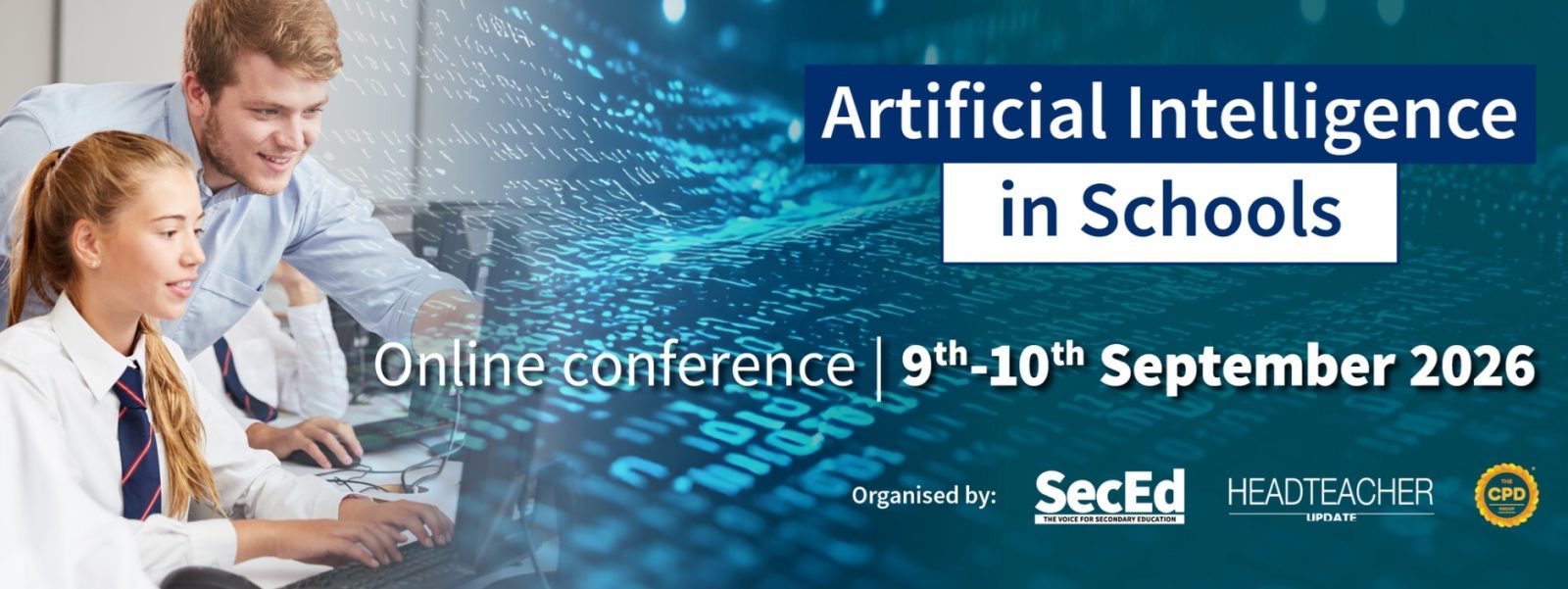
In September I will be taking part in Artificial Intelligence in Schools: Opportunities and Risks, an online conference hosted by Mark Allen Group across Wednesday 9 and Thursday 10 September 2026. My session runs on the Wednesday.
The event arrives at an important moment. AI is no longer a distant prospect for schools. It already shapes how teachers plan, how pupils learn, and how leaders think about workload and professional development. The question now is not whether AI will affect education, but how schools shape that change wisely.
That is why the theme matters. The potential is real: lower workload, better access to feedback, more personalised support, and new ways to understand what happens in classrooms. So are the risks: weak data protection, damaged trust, surveillance by another name, overclaiming, and tools adopted because they sound impressive rather than because they solve a real problem. Schools need space to weigh both honestly, without hype and without fear.
That tension is where my own work sits. It began with an ordinary, very human problem: how do we give teachers feedback that is specific, timely, actionable and regular, without creating an impossible workload for leaders, coaches or teachers themselves?
Traditional observation cycles matter. Human coaching matters. Professional trust matters. But in the reality of school life it is very hard to give every teacher meaningful, personalised feedback often enough to support sustained improvement. Not because people do not care, and not because leaders do not value development, but because time and capacity are real constraints.
Starlight was built in response to that problem. It uses secure lesson audio and transcript-based analysis to help teachers reflect on their own practice, surfacing patterns in areas such as questioning, explanation, adaptive teaching, literacy and classroom interaction. The principle behind it is simple: teachers should receive useful evidence about their practice, privately and professionally, in a way that helps them think. In my school, colleagues have now uploaded over 1,500 lessons across this academic year, which has taught us a great deal about what scaling feedback actually looks like in a working school.
Build vs buy: A teacher’s case study in scaling AI coaching
My session explores a decision many school leaders now face. When it comes to AI, should a school buy something off the shelf, build something itself, or take a third route that few consider: working with, or founding, a specialist provider?
That third route is part of the Starlight story. Starlight did not begin as a technology project looking for a problem. It began with a classroom and leadership problem that existing tools did not solve, and the journey that followed led to STAR21, the company behind the platform.
The session is not a pitch. That would miss the point, and the audience would see through it. It is an honest case study: why off-the-shelf tools did not meet the need I could see, why I do not think most schools should try to build their own AI systems from scratch, and what I learned by taking the founder route instead.
It will also work through the practical questions every leader should ask before committing to any platform, whichever route they choose:
• How is data protected?
• Who owns the output?
• How will staff understand and trust the system?
• What role do unions and professional associations need to play?
• How does the tool fit existing CPD, coaching and school improvement work?
• What are the real costs, risks and trade-offs?
• And, most importantly, does the tool make teachers feel more trusted, or less?
For me, that last question is the one that matters most. AI should support teachers, not monitor them. It should reduce workload, not add another administrative layer. It should strengthen professional reflection, not turn development into surveillance. And it should help schools scale coaching while keeping teachers firmly at the centre.
My thanks to Pete Henshaw, Editor of SecEd, Headteacher Update and Safeguarding Digest, for organising the conference and for the invitation to take part. It is appreciated because the theme matters so much to schools right now. Education needs grounded conversations about AI: what it can do, what it cannot, what it should never be used for, and how schools can make decisions that protect trust while opening up genuinely useful possibilities. That is the conversation I want to be part of.
You can view the full programme here:
https://schoolsai.co.uk/LIVE/en/page/programme
If you'd like to see what a Starlight report looks like for a lesson in your own school, you can book a demo at https://starlightmentor.com/demo-request.
Spark Insight with Starlight, and help shape an AI future where teachers remain trusted, supported and firmly at the centre of professional growth.
🎥 Subscribe to our channel here: https://www.youtube.com/@Star21-ai
🌐 Read more on our blog: starlightmentor.com/blog
💡 Explore the platform: www.starlightmentor.com
🐦 Follow us on X: @star21starlight
The Insight Engine is written by Adam Sturdee, co-founder of Starlight, the UK’s first AI-powered coaching platform, and a senior leader with responsibility for teaching, learning and coaching. This blog is part of a wider mission to support educators through meaningful reflection, not performance metrics. It documents the journey of building Starlight from the ground up, and explores how AI, when shaped with care, can reduce workload, surface insight, and help teachers think more deeply about their practice. Rooted in the belief that growth should be private, professional, and purposeful, The Insight Engine offers ideas and stories that put insight—not judgment—at the centre of development.