Why the next chapter of the evidence movement is written in your classroom, not about it
For thirty years, teachers have been told to follow the evidence. It is good advice, and the profession is better for taking it. But a fair question has always lingered underneath: whose evidence, from whose classrooms, gathered when, and by whom?
A short history of a good idea
Evidence based practice did not begin in education. It began in medicine, where David Sackett and colleagues defined it in the BMJ in 1996 as the conscientious use of current best evidence in making decisions about individual patients. Education soon asked itself the same question. In the UK, the movement gathered real momentum with the founding of the Education Endowment Foundation in 2011, whose Teaching and Learning Toolkit is now a fixture of CPD planning in thousands of schools. Internationally, John Hattie’s Visible Learning synthesised many thousands of studies into effect sizes, and in the United States the What Works Clearinghouse formalised tiers of evidence under ESSA.
The achievement of this movement is real. Teaching now takes research seriously. Interventions are questioned, fads are challenged, and phrases like effect size and randomised trial sit comfortably in staffroom conversation.
The gap the movement never closed
Yet almost all of this evidence shares one characteristic. It is evidence about classrooms in general, not about your classroom in particular. A meta-analysis can tell you that questioning quality matters on average, across thousands of lessons. It cannot tell you how long you actually waited after your last question to Year 9 on Tuesday, period 3.
The evidence has also tended to flow in one direction: generated in universities, synthesised in reports, and delivered to teachers months or years later through training days and toolkits. Teachers were positioned as consumers of evidence rather than producers of it. The expertise sat somewhere else.
Evidence from your own lesson, minutes after teaching it
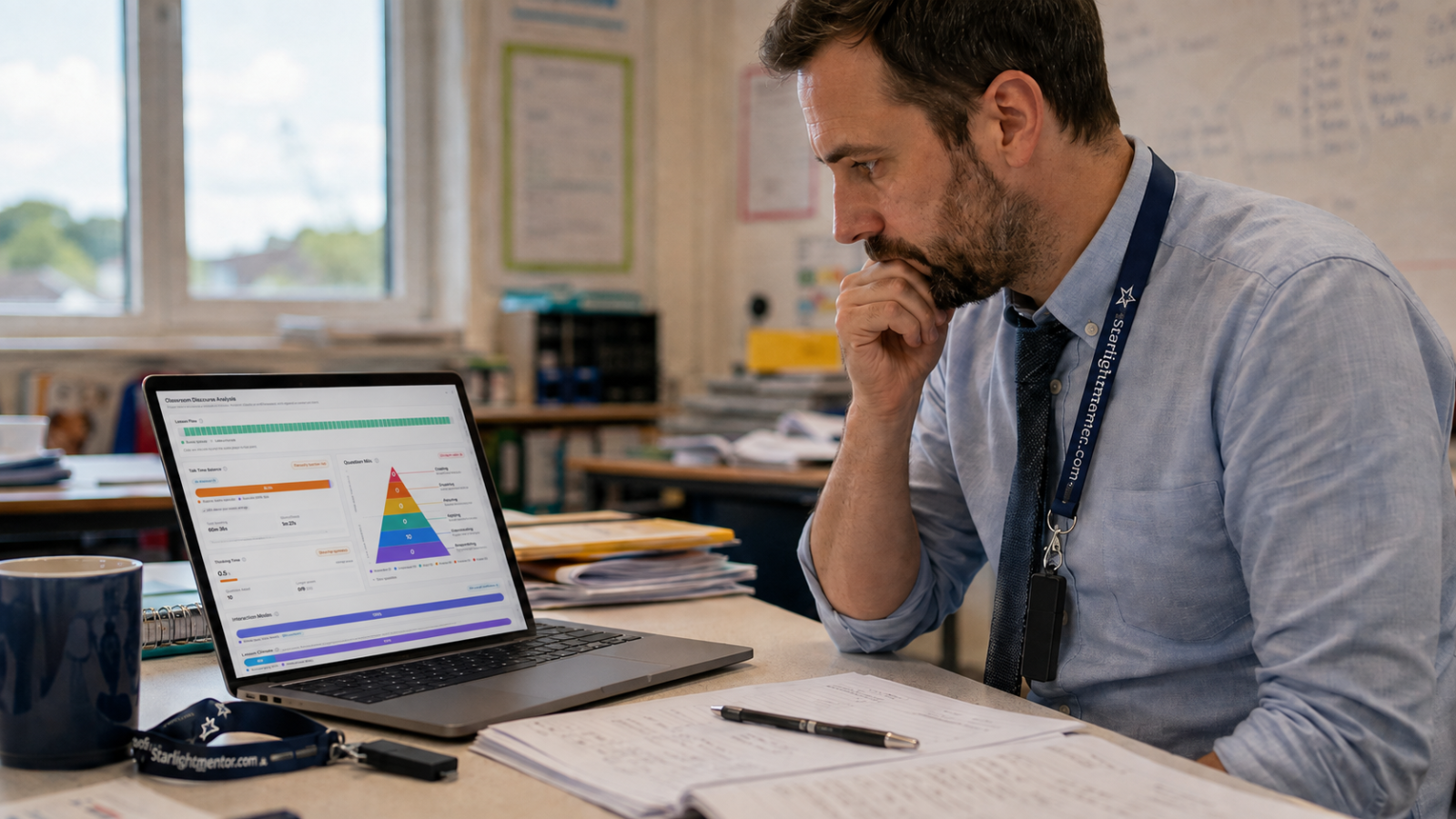
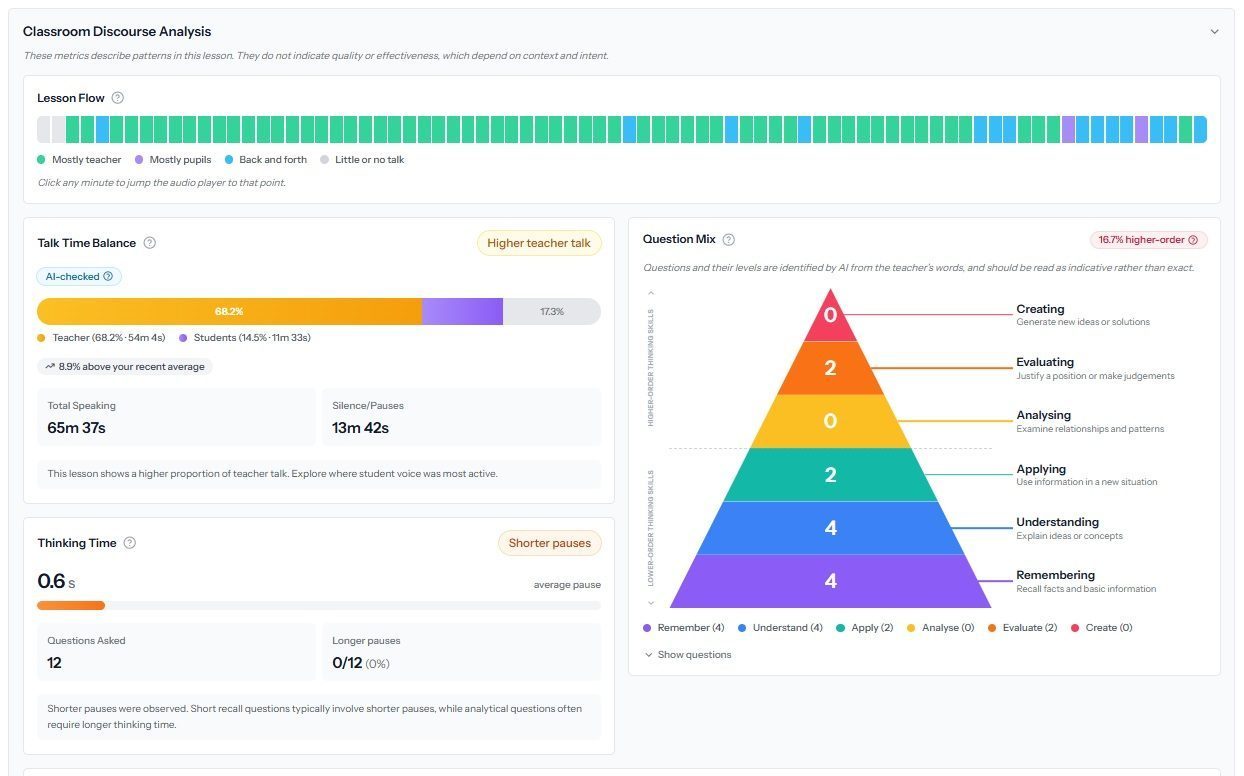
This is where the story turns. Starlight lets a teacher record a whole lesson, upload the audio, and receive a private coaching report within minutes. That report is built on direct evidence from the lesson itself, including:
Wait time. Mary Budd Rowe’s classic research showed that pausing for three seconds or more after a question transforms the depth of pupil responses. Starlight measures your actual wait times, lesson by lesson.
Question categorisation. Every question is classified against Bloom’s revised taxonomy, so you can see the balance of recall, application and analysis in your questioning, not guess at it.
Teacher and student talk. The ratio of teacher talk to student talk, and how it shifts across the lesson, drawing on the same dialogic tradition that underpins tools like Cambridge’s T-SEDA framework.
Sentiment and tone. The emotional texture of the lesson, including moments of encouragement, challenge and warmth.
Lesson flow. A timeline of how the lesson unfolded, from exposition to discussion to independent practice.
None of this arrives as a grade or a judgement. It arrives as a mirror. The enhanced feedback report highlights strengths evidenced in the transcript, offers a small number of high-leverage next steps, and prompts reflection. It is private to the teacher by default.
Specific, timely, actionable, regular
The evidence movement has always known that feedback works best when it is specific, timely, actionable and regular. This is the STAR standard at the heart of Starlight, and it is worth noticing how rarely traditional evidence based practice meets it. A research summary is specific to a population, not to you. It is timely in publication terms, not in teaching terms. And however actionable it may be, it is almost never regular, because no external observer can sit in your classroom every week.
Transcript-based coaching changes each of those terms. The evidence is specific to your lesson, arrives the same day, points to concrete next steps, and can repeat as often as you choose to press record. In that sense, Starlight is not a departure from evidence based practice. It is, in some ways, its most complete expression yet: best evidence, applied to the individual classroom, at the point of decision.
Every teacher a researcher
There is an older tradition that anticipated all of this. Action research, from Kurt Lewin’s original cycles to Lawrence Stenhouse’s vision of the teacher as researcher, has long argued that the classroom itself is a legitimate site of inquiry. What held it back was never the idea. It was the workload. Recording, transcribing and analysing your own lessons by hand is a project measured in weekends.
Starlight collapses that cycle into days. Read this week’s report and notice your wait times are short. Decide to pause after every question tomorrow. Record again on Friday and see whether the evidence moved. That is action research, run at the rhythm of a normal teaching week, owned entirely by the teacher.
The expert has not been removed. The expertise has moved closer
It is sometimes suggested that AI tools remove the expert from professional learning. The truth is closer to the opposite. The research base still matters, and Starlight’s analysis is deliberately grounded in it. What changes is who holds the evidence. It no longer has to travel from the ivory tower to the staffroom before a teacher can act on it. It is generated in the classroom, returned to the teacher, and used at their discretion.
That shift matters for autonomy as much as for effectiveness. A teacher with weekly evidence of their own practice develops something no external programme can deliver: a high, honest self-awareness of how they teach, and a habit of testing how they might teach better. Coaching, not compliance. Insight, not surveillance. Growth, not grading.
Evidence based practice asked teachers to trust the evidence. Starlight lets teachers own it.
Ready to see the evidence of your own practice?
Book a personalised demo and discover what a single recorded lesson can reveal: starlightmentor.com/demo-request
Spark Insight with Starlight, and let the evidence of your own classroom light the way.
The Insight Engine is written by Adam Sturdee, co-founder of Starlight, the UK’s teacher-first AI-powered coaching platform, and a senior leader with responsibility for teaching, learning and coaching. This blog is part of a wider mission to support educators through meaningful reflection, not performance metrics. It documents the journey of building Starlight from the ground up, and explores how AI, when shaped with care, can reduce workload, surface insight, and help teachers think more deeply about their practice. Rooted in the belief that growth should be private, professional, and purposeful, The Insight Engine offers ideas and stories that put insight, not judgment, at the centre of development.